Pneumatic vacuum generatorssingle-stage, multi-stage, and multifunctional

- Official Vuototecnica distributors
- Up to 12 months warranty
- Single-stage, multi-stage and multifunction
- Technical support in choosing the generator
Prefer to talk to a technician? +39 0331 772410 · info@interfluid.net

Price and availability within 24 hours
Tell us how much vacuum you need (suction capacity, supply pressure, type of connection) or the code of the Vuototecnica vacuum generator you are looking for: a technician will reply within 24 working hours.
Pneumatics, Vacuum, and Lubrication
Applications
- Industrial robotics
- Woodworking industry
- Food industry
- Plastics and rubber industry
- Glass industry
- Ceramics industry
- Printing/Paperboard industry
Vuototecnica vacuum generators: technical data
Pneumatic vacuum generators produce vacuum from compressed air, with no moving parts. The range includes single-stage, multi-stage and multifunction versions, also in Low Pressure versions that work with supply pressures down to 4 bar to save energy.
| Single-stage | Venturi principle; suction from 1 to 20 m³/h; ultimate pressure down to 100 mbar abs; anodized aluminium (brass or aluminium ejectors); high-noise-reduction silencer can be fitted on the R exhaust port |
| Multi-stage | maximum vacuum 90%; suction from 3 to 750 m³/h; ultimate pressure 100 mbar abs; lower compressed air consumption than single-stage at the same suction flow |
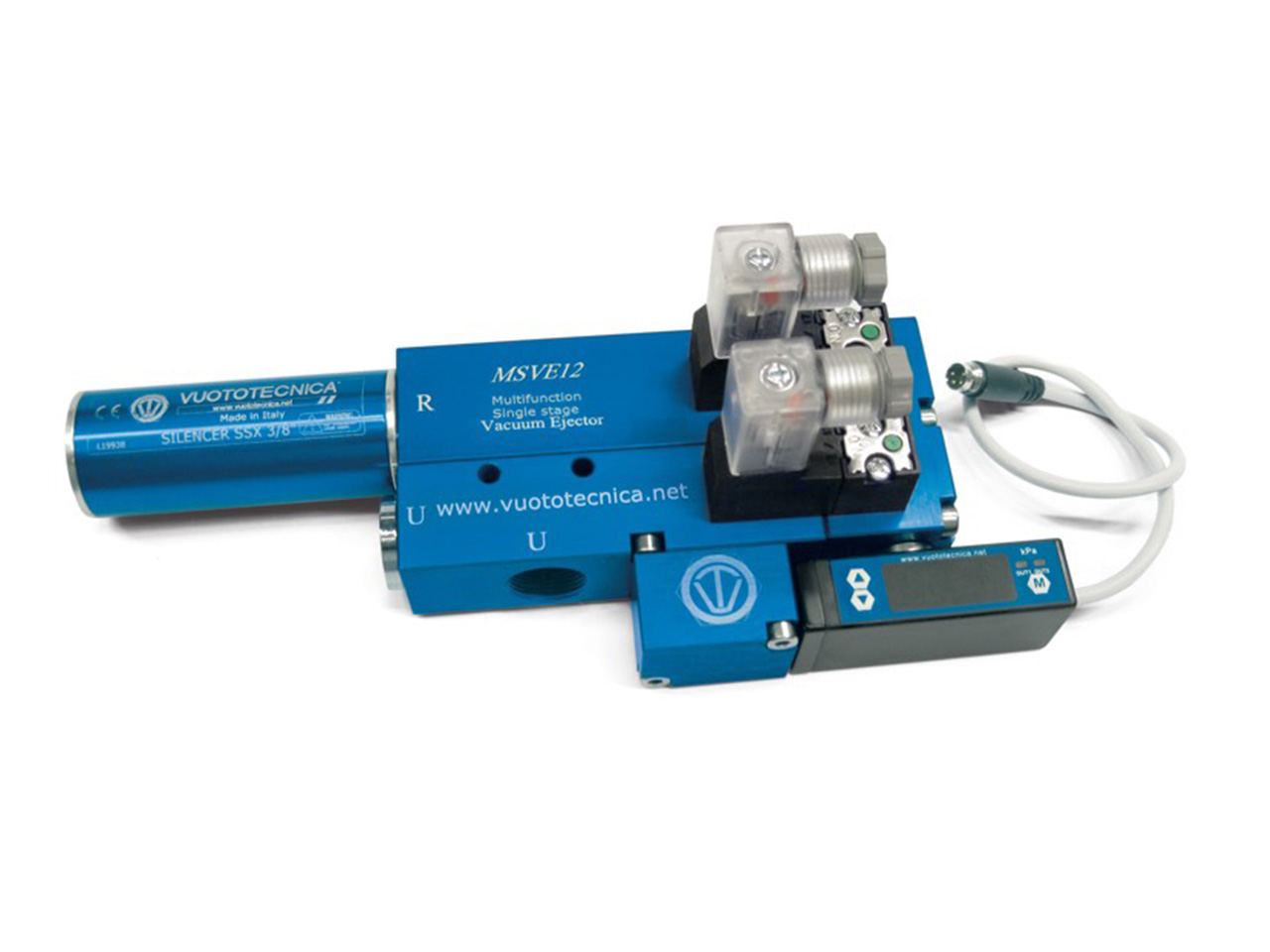
| Multifunction | single-stage or multi-stage with supply micro solenoid valve, blow-off micro solenoid valve, screw flow regulator and digital vacuum switch |
| Supply pressure | generally 6 bar; multi-stage from 1 to 6 bar; Low Pressure versions down to 4 bar |
| Operating temperature (multi-stage) | from -20 to +80 °C |
| Materials (multi-stage) | anodized aluminium, stainless steel ejectors and screws; EPDM or, on request, VITON seals and flap valves |
| Explosive atmospheres | multi-stage generators can be used when powered by compressed air only |
| Brand | Vuototecnica, official distributors |
To reduce maintenance, good filtration of both the compressed air and the sucked air is important. How the three families work is described in the sections below.
Vacuum generator FAQ
How does a single-stage vacuum generator work?
It is based on the Venturi principle: compressed air flowing through the ejector creates the vacuum. It is normally supplied at 6 bar, with suction from 1 to 20 m³/h and an ultimate pressure down to 100 mbar abs.
What is the difference between single-stage and multi-stage vacuum generators?
A multi-stage generator passes the compressed air through several ejectors in series: at the same suction flow it uses less compressed air than a single-stage one, reaches a maximum vacuum of 90% and covers capacities from 3 to 750 m³/h, with a supply pressure from 1 to 6 bar.
What does Low Pressure version mean?
It is a version that gives excellent performance with compressed air at lower pressures, down to 4 bar, with considerable energy savings. It is available for the single-stage range and for some multi-stage families.
What is a multifunction vacuum generator?
It is a single-stage or multi-stage generator assembled with a supply micro solenoid valve, a blow-off one, a screw flow regulator and a digital vacuum switch. The vacuum switch cuts the supply when the vacuum reaches the set value, reducing compressed air consumption.
Can multi-stage generators be used in explosive atmospheres?
Yes, when powered by compressed air only. They can work in environments with temperatures from -20 to +80 °C.
Tell us flow rate, supply pressure and type of connection: we will recommend the most suitable generator.
Request a quoteDescription
The operation of single-stage vacuum generators is based on the Venturi physical principle.
In general, vacuum generators are powered with a pressure of 6 bar. The vacuum generator range includes a Low-Pressure version that allows excellent performance with compressed air supply at lower pressures (up to 4 bar), enabling significant energy savings.
It is possible to equip the vacuum generators with a high-sound-reducing silencer, which is installed on the R discharge connection.
Single-stage vacuum generators are made of anodized aluminum (ejectors in brass or aluminum).
Features
- Suction capacity from 1 to 20 m³/h
- ltimate pressure up to 100 mbar abs
Advantages
- Easy cleaning
- High emptying speed
- Quick and efficient work cycles
Multi-stage vacuum generators produce a maximum depression of 90% and have various suction capacities. The compressed air supply pressure ranges from 1 to 6 bar.
Multi-stage generators utilize the kinetic energy of the compressed feeding air by passing it through a series of appropriately sized ejectors before releasing it into the atmosphere. This system allows for a lower consumption of compressed air, at the same flow rate, compared to single-stage vacuum generators.
Some families of multi-stage vacuum generators also have a Low Pressure version that allows excellent performance with compressed air supply at lower pressures (up to 4 bar), enabling significant energy savings.
To reduce maintenance interventions, it is important to implement a good filtration of both the compressed and aspirated air.
Features
- Suction capacity from 3 to 750 m³/h
- Ultimate pressure 100 mbar abs
- They can be used in potentially explosive atmospheres with compressed air supply only
- They can be used in environments with variable temperatures from -20 to +80 °C
- Made of anodized aluminum (with ejectors and stainless steel screws)
- Sealing gaskets and flap valves in EPDM or VITON on request
Advantages
- High quietness and possibility of continuous use (without heat development) due to the absence of moving parts
- Small size, light, compact, and space-saving in relation to their large suction capacity
The single-stage and multi-stage generators can be multifunctional by assembling:
- A micro solenoid valve that supplies compressed air to the generator
- A micro solenoid valve for blowing out the compressed air
- A flow regulator essential for dosing the exhaust air
- A digital vacuum switch with a display and LEDs that indicate the switchings to manage the supply of compressed air and provide a signal for safely starting the cycle
Operation
By activating the micro solenoid valve for compressed air supply, the generator begins to create the required vacuum. When the maximum specified value is reached, the vacuum switch interrupts the supply of compressed air to reduce energy consumption.
In this way, the vacuum level is maintained within the predefined safety values (hysteresis), allowing significant compressed air savings. A second signal from the vacuum switch, also adjustable and independent of the first, can be used to start the work cycle when the achieved vacuum level is appropriate for use.
At the end of the work cycle, the air-feeding micro solenoid valve deactivates, and simultaneously, the exhaust micro solenoid valve activates to quickly restore atmospheric pressure for further use.
Are you interested in our products?
Register to Fluid-Hub.net, the digital portal for our products.
Buy directly online and get an additional 2% discount and many other benefits!
Vacuum generators' average stock
| Series | Average stock |
|---|---|
| MSVE | 🚚 Orderable from supplier |
| GVMM | ✅ Usually available |
| PVP | ✅ Usually available |
| M | ✅ Usually available |
| PVP large capacity | 🚚 Orderable from supplier |
Download
- Vuototecnica catalogueDownload Vuototecnica catalogue
Why Your Fluid Mate?

Presence in the territory

Automated warehouse
To monitor the order flow with precision, accuracy and speed

Wide range of products
We offer you multiple alternatives to quickly meet your request
Specialized technical support
We study the comparisons with other brands and provide support for your project
Assembly and testing of pneumatic panels
We design, draw, assemble and test control pneumatic panels

E-commerce
To learn more
Pneumatics • 2 August, 2024
Vacuum generators: how they optimize industrial production
Vacuum generators are indispensable tools in numerous industrial sectors due to their ability to enhance the efficiency and quality of production processes. These devices find applications in various fields, from the processing of chemical and cosmetic products to the production of food and beverages, and their ability to handle products gently makes them an essential component for many companies.