
Electric cylinders and linear actuatorsSizing and comparison with pneumatic and hydraulic cylinders
Pneumatics, vacuum and lubrication
Applications
- Packing
- Automation and robotics
- Automotive
- Plastics and rubber
- Industry printing and paperboard industry
- Pharma
- Food industry
- Glass industry
- Ceramics industry
- Sheet metal industry
- Wood industry
- Medical



Description
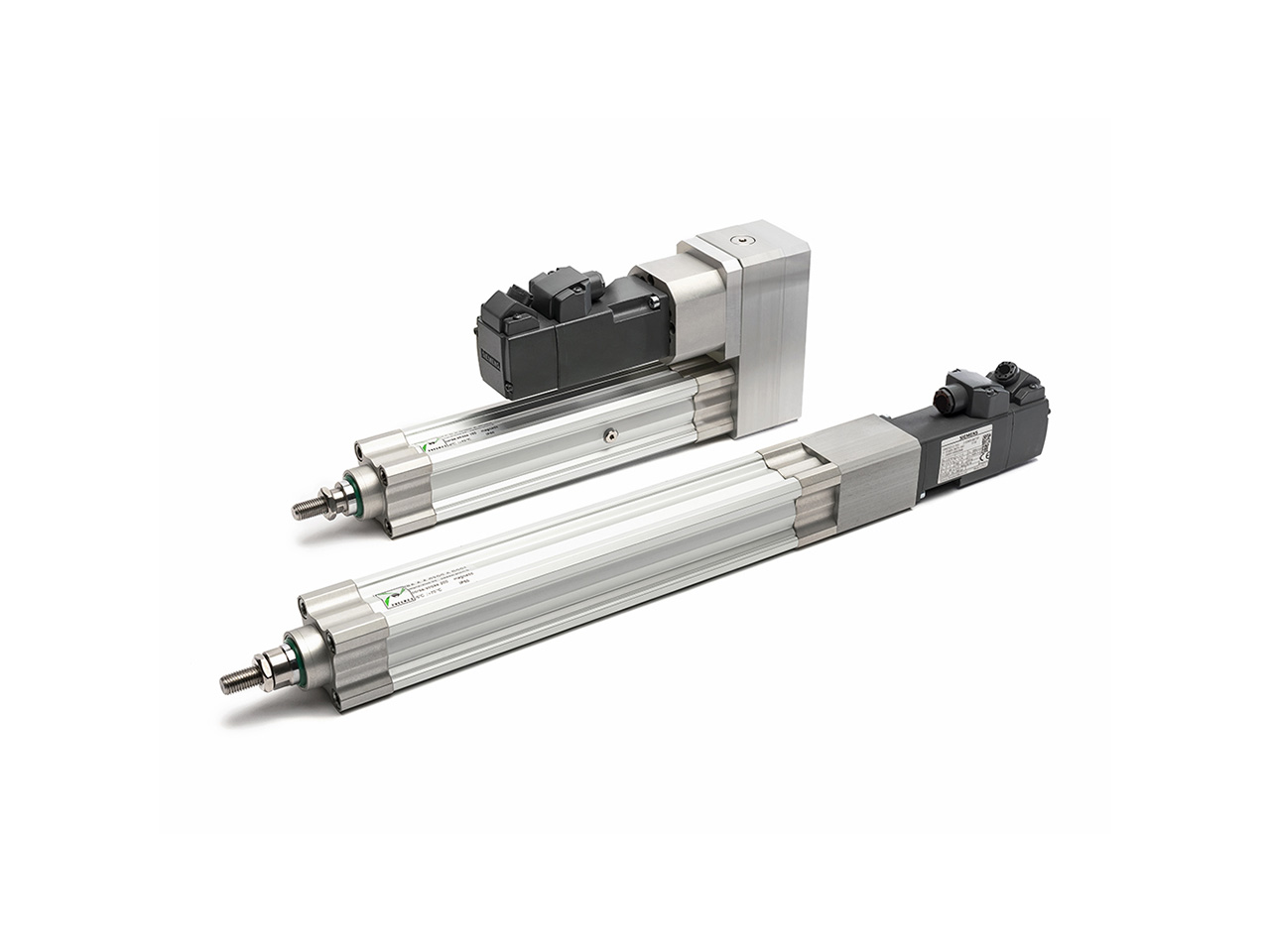
Pneumax 1800 series electric cylinders use a worm screw with ball recirculation for motion transmission, allowing the conversion of rotary motion from an electric motor into precise linear motion.
These cylinders control acceleration, deceleration and intermediate position stops in a controlled manner with remarkable repeatability precision, down to hundredths of a millimeter.
The 1800 Series offers high energy efficiency, reducing consumption and contributing to overall energy savings. Additionally, it is designed to seamlessly integrate with Siemens motors, and assembly kits suitable for any motorization type are available upon request
Features
- Available diameters: 32, 40, 50, 63
- Versions with in-line or parallel motors
- SIEMENS brushless motors
- IP65 protection rating
- Anti-rotation piston
- Prepared for the use of magnetic sensors
- Wide range of motor mounting accessories and interfaces
- Designed with mounting interfaces compliant with ISO 15552 standard
AutomationWare's Mech series electric cylinders are based on ball screw technology, also available with caged balls, to deliver high speed and outstanding thrust performance. They are an alternative to pneumatic and hydraulic systems in every application that requires cleanliness, motion control and repeatability — including sterile environments such as Food and Pharma.
The series is organised into three families, based on dimensions, payload and application context:
- Mech Value — compact cylinders delivering high performance in speed and force, available with in-line or parallel-drive motorisation, ideal where space is limited.
- Mech Line / Force / Plus — modular standard range, with thrusts above 200 kN and in-line or parallel configurations. Suitable for most industrial applications with demanding payload and durability requirements.
- Mech Extreme — the version for heavy-duty applications: dynamic load up to 700 kN, reinforced steel structure and ISO 5 ground ball screw with NSK inside components.
Features
- Ball screw technology (also caged-ball)
- Wide payload range: up to 700 kN in the Extreme version
- In-line or parallel/offset motorisation
- High-efficiency planetary gearboxes
- Electronic drive with encoder
- Compatible with AutomationWare motors and drives (AW-Motion range)
The electric axes in the 18T series by Pneumax have been designed with the aim of ensuring speed and precision in motion control, regardless of the application. The top priority is always maximum reliability in every operation.
These electric axes are available in two transmission variants: tooth
belt or ball screw driven. They are also available with single internal or double external guides, allowing for further customization.
To maximize integration flexibility, the electric axes can be supplied without motors or with Siemens motorization, and with suitable flanges for other motorizations, ensuring maximum adaptability to various application contexts.
Features
- Available sizes: from 42 to 105
- Maximum speed for belt-driven electric axes: from 1 to 3 m/s
- Maximum speed for screw-driven electric axes: from 0.75 to 1.5 m/s
The AutomationWare Linear Systems are the advanced mechatronic range of electric linear actuators within the Pneumax Group, designed for applications that require high dynamics, multi-axis Cartesian configurations and broad customisation of motorisation and accessories. They are available in two drive technologies.
Belt-driven Linear Systems
Offer the best combination of speed, force and productivity on long strokes. The polyurethane belt with steel cords runs inside protected channels in the profile; in the High Protection versions, a steel cover plate running through the carriage adds an extra layer of protection against dust and debris.
The idler head includes a tensioning system, and belt replacement can be carried out without removing the unit from the application
Ball screw-driven Linear Systems
Built with ISO 7 ball screws as standard (ISO 5 on request), they deliver high positioning accuracy thanks to high-resolution encoders. Internal components are protected by a steel cover plate or bellows.
Features
- Compact high-efficiency planetary gearboxes
- Servo-Stepper or Brushless motorisation
- Configurable as single units or multi-axis Cartesian systems (XYZ)
- Wide choice of sensors (Hall effect, inductive, electromechanical)
- Additional carriages for load distribution
- Flanges and shaft locking devices compatible with any motor brand
Pneumatic, electric or hydraulic?
Send us load, stroke, speed and cycle time: our engineers size the axis and tell you which technology fits best.
The consultation is free.
Electric cylinders and electric axes: when to choose them
A linear motion on a machine can be achieved with three technologies: pneumatic, electric and hydraulic. Interfluid distributes all three (Pneumax for pneumatics, Pneumax and AutomationWare for electric, Atos for hydraulics). This lets us advise you without a built-in preference: we assess axis by axis which technology fits best, based on force, accuracy, energy use and total cost.
Our technical department supports you in sizing, in choosing between an electric cylinder and an electric axis, and in assessing when a pneumatic or hydraulic cylinder can be replaced by an electric solution.
Electric cylinder or electric axis: the difference
- Electric cylinder (rod-type linear actuator): a rod pushes and pulls the load, like a pneumatic or hydraulic cylinder. The motor drives a ball screw. Pneumax 1800 series cylinders have ISO 15552 mounting interfaces, so they can replace a pneumatic cylinder with limited mechanical changes.
- Electric axis (linear system): a carriage runs along a guided profile, driven by a belt or a screw. It is the solution for long strokes, high speeds and multi-axis Cartesian systems (XYZ), such as pick & place gantries.
Pneumatic, electric or hydraulic: the comparison
| Parameter | Pneumatic cylinder | Electric cylinder / axis | Hydraulic cylinder |
|---|---|---|---|
| Positioning | Point to point between two end stops | Continuous, multiple positions from the PLC | Point to point; continuous with servo cylinders and transducer |
| Accuracy | Depends on end stops and cushioning | Repeatability down to ±0.01 mm (screw) | High with servo cylinders and closed-loop control |
| Force | Limited by network pressure (typically 6 bar) and bore | Over 200 kN (Mech), up to 700 kN dynamic (Mech Extreme) | Highest for its size: up to 320 bar, bores up to 400 mm (Atos) |
| Speed | High, hard to regulate | Programmable profiles, up to 3 m/s (belt axes) | Adjustable with proportional valves |
| Format change | Mechanical (moving sensors) | By software (PLC recipe) | Mechanical, or by software with servo cylinders |
| Energy use | Compressor always under pressure, typical network leaks 20-30% | Only while moving or holding the load | Power unit running throughout the cycle |
| Cleanliness | Air exhausts | No air or oil: suitable for food and pharma | Risk of oil leakage |
| Process data (4.0) | Only with extra sensors | Position, force and current in real time | With position and pressure transducers |
| Component cost | Lowest | Higher than pneumatic | Higher, plus the power unit |
Rule of thumb: pneumatics for simple moves between two positions, electric when you need intermediate positions, control and data, hydraulics when you need very high forces in little space or shock resistance. On many machines the best solution is hybrid.
How to choose: the questions to ask for each machine axis
| Question | If the answer is yes | Recommended technology |
|---|---|---|
| Do you need more than two positions or software format changes? | Positions programmed from the PLC | Electric |
| Does the end customer require process data, predictive maintenance or energy efficiency? | Industry 4.0 specification, multi-shift machine | Electric |
| Is the motion a simple back-and-forth, possibly in dusty or wash-down environments? | Few components, maximum simplicity | Pneumatic |
| Do you need very high forces in tight spaces, or are there shock loads? | Thrust beyond electric cylinder performance | Hydraulic |
| Do you want to remove the power unit and the risk of oil leaks at the same force? | Forces within the 700 kN dynamic load of the Mech range | Electric instead of hydraulic |
When an electric cylinder replaces a hydraulic cylinder
Until a few years ago electric actuators were limited to low and medium forces. Today AutomationWare Mech electric cylinders exceed 200 kN of thrust, and the Mech Extreme version, with reinforced steel structure and ISO 5 ground screw, reaches 700 kN dynamic load. In this range the electric cylinder becomes a real alternative to hydraulics:
- it removes the power unit, piping and oil filtration;
- it eliminates the risk of leaks, which matters in clean environments;
- it uses energy only while working;
- it provides accurate positioning and force control without proportional valves.
Hydraulics remains the right choice for very high forces in compact spaces, shock loads and heavy-duty applications. In these cases we offer Atos hydraulic cylinders and servo cylinders, up to 320 bar, also with position transducer for closed-loop control.
How to size an electric axis
To propose the right solution we need the following data:
- Load and force: mass to move or thrust required, and how it varies along the stroke.
- Stroke: usable length of the motion.
- Speed and acceleration, and the cycle time to meet.
- Accuracy: required positioning repeatability.
- Duty cycle: number of cycles, shifts, dwell times under load.
- Orientation: horizontal, vertical (with motor brake if needed) or inclined.
- Environment: dust, wash-down, temperature, protection rating.
- Control: PLC and communication protocol, motor already specified or to be supplied.
With these data we choose the transmission: belt for long strokes and high speeds (up to 3 m/s, typical repeatability ±0.05 mm), ball screw for higher thrust and accuracy (typical repeatability ±0.01 mm). We then define size, gearbox and motor.
The range: Pneumax and AutomationWare electric cylinders and axes
| Series | Type | Main features |
|---|---|---|
| Pneumax 1800 | Electric cylinder | Bores 32, 40, 50, 63; ISO 15552 interface; Siemens brushless motors in-line or parallel; IP65 |
| AutomationWare Mech Value | Compact electric cylinder | High speed and force in little space; in-line or offset motor |
| AutomationWare Mech Line / Force / Plus | Electric cylinder | Modular range, thrust over 200 kN; in-line or parallel configurations |
| AutomationWare Mech Extreme | Heavy-duty electric cylinder | Up to 700 kN dynamic load; ISO 5 ground screw |
| Pneumax 18T | Electric axis | Sizes 42 to 105; belt (1-3 m/s) or screw (0.75-1.5 m/s); single internal or double external guide |
| AutomationWare linear systems | Belt or screw electric axis | Sizes 45, 60, 80, 120 (90 and 160 for some series); ISO 7 screws, ISO 5 on request; XYZ multi-axis systems |
| AutomationWare AW Drives | Drives | Stepper or brushless motors; EtherCAT, PROFINET, CANopen, ModBus; STO safety function |
The full features of each series are described above on this page and in the downloadable catalogues.
Further reading
- Electric axes vs pneumatics: when to switch
- Electric axes vs pneumatic cylinders: selection guide for machine builders
- Pneumatic cylinders and hydraulic cylinders
Application examples
Two typical situations in which we propose that machine builders switch to electric, and what changes in practice.
From pneumatic to electric: pick & place on a pharmaceutical blister machine
The situation. The pick & place module of a blister machine uses pneumatic cylinders to pick and place the product. At every format change the operator moves the end stops and adjusts the flow controls: the machine stands still for tens of minutes and the first cycles produce scrap. Air exhausts are also an issue in a controlled-contamination area.
The solution. AutomationWare electric axes in a Cartesian layout, with AW Drives connected to the PLC. The positions for each format are stored as recipes. Simple ejection movements stay pneumatic: a hybrid solution.
What changes.
- format change drops from tens of minutes to a few minutes, by recalling the recipe from the operator panel;
- no air exhausts in the product area, and less noise;
- much lower compressed air consumption: in documented packaging cases, replacing the most air-hungry actuators cut air consumption by more than 30%;
- position and force of every axis available for predictive maintenance.
From hydraulic to electric: punching and forming of sheet metal parts
The situation. A punching and forming station for sheet metal parts (for example brake components) runs on a hydraulic cylinder with a dedicated power unit. The power unit runs for the whole shift, oil leaks onto the line and the force varies with oil temperature: some parts must be re-checked or scrapped.
The solution. An AutomationWare Mech series electric cylinder, sized on the force actually needed along the stroke, with force and position control and the force-stroke curve recorded at every cycle. The power unit, piping and oil management are removed.
What changes.
- repeatable force, independent of temperature, with fewer parts to re-check;
- traceability of every part through the stored force-stroke curve;
- lower energy use: an electric servo drive works at efficiencies around 80%, against the 40-50% typical of a hydraulic circuit, and draws power only during the stroke;
- zero leaks, no oil or filter changes, floor space freed at the line.
The critical point is sizing: the required force is not simply the old cylinder's pressure times area, but the real force profile along the stroke. This is where our technical department comes in.
Electric cylinders and axes: frequently asked questions
What is the difference between an electric cylinder and an electric axis?
An electric cylinder has a rod that pushes and pulls like a pneumatic cylinder and can use the same ISO 15552 mounting interfaces. An electric axis moves a carriage along a profile, driven by a belt or a screw, and suits long strokes and multi-axis Cartesian systems.
When should a pneumatic cylinder be replaced by an electric axis?
When you need intermediate positions, software format changes, speed and acceleration control, process data for Industry 4.0 or lower compressed air consumption. For simple moves between two fixed positions the pneumatic cylinder often remains the most economical choice.
Can an electric cylinder replace a hydraulic cylinder?
Yes, when force and duty cycle are within its range: AutomationWare Mech electric cylinders exceed 200 kN and the Extreme version reaches 700 kN dynamic load. The power unit, piping and the risk of oil leaks are eliminated. For very high forces in compact spaces or shock loads, hydraulics generally remains the better solution.
What do you need to size an electric axis?
Load or required force, stroke, speed and acceleration, positioning accuracy, duty cycle, orientation (horizontal or vertical), working environment and control system. With these data our engineers select transmission, size and motor.
Belt or ball screw electric axis?
Belt drives suit long strokes and high speeds (up to 3 m/s on Pneumax 18T axes, typical repeatability ±0.05 mm). Ball screw drives offer higher thrust and accuracy (typical repeatability ±0.01 mm) over shorter strokes.
Are the electric axes compatible with my PLC?
AutomationWare AW Drives support ModBus RTU, CANopen CiA 402, EtherCAT, PROFINET RT and IRT, and include the STO safety function.
Why Interfluid
- Three technologies, one partner: pneumatic, electric and hydraulic, for a neutral choice axis by axis.
- Official Pneumax distributors, with the AutomationWare mechatronic range.
- Sizing support from our technical department, from the first analysis to motor and drive selection.
- Experience on machine builders' equipment: we also design and build pneumatic control panels, useful in hybrid solutions.
Average stock of cylinders and electric axes
| Series | Average stock |
|---|---|
| 1800 | 🚚 Orderable from supplier |
| 18T | 🚚 Orderable from supplier |
| Series | Average stock |
|---|---|
| Mech | 🚚 Orderable from supplier |
| Linear Systems - Belt | 🚚 Orderable from supplier |
| Linear Systems - Ball screw | 🚚 Orderable from supplier |
Download
- Pneumax electric cylinders 1800 series catalogueDownload Pneumax electric cylinders 1800 series catalogue
- Pneumax electric axes 18T series catalogueDownload Pneumax electric axes 18T series catalogue
- AutomationWare Mech series catalogueDownload AutomationWare Mech series catalogue
- AutomationWare linear actuators catalogueDownload AutomationWare linear actuators catalogue
Why Your Fluid Mate?

Presence in the territory

Automated warehouse
To monitor the order flow with precision, accuracy and speed

Wide range of products
We offer you multiple alternatives to quickly meet your request

Specialized technical support
We study the comparisons with other brands and provide support for your project

Assembly and testing of pneumatic panels
We design, draw, assemble and test control pneumatic panels
