Skip to content

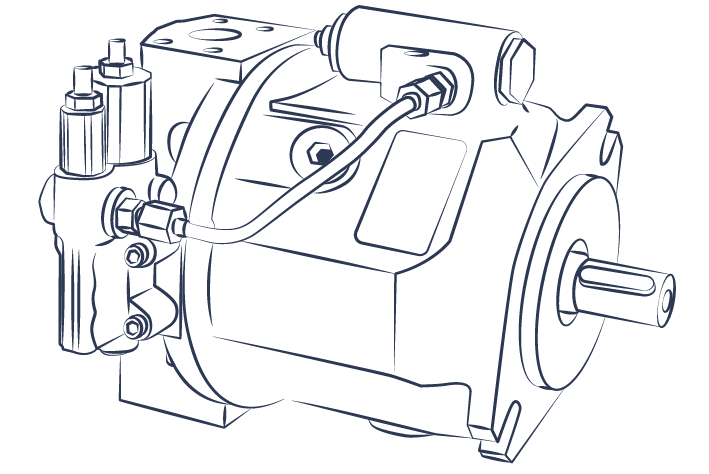
Axial piston pumps

This kind of hydraulic piston pumps are the ideal solution for open circuit applications with medium and high pressure, thanks to their ability to handle a hydraulic system with large flow rates and high pressures.

Typical applications include:

  • Hydraulic power units
  • Mobile and construction equipment
  • Marine auxiliary power
  • Metal forming and stamping
  • Machine tools and oil field equipment
  • Steel industry


Pompa a pistoni assiali

They are variable displacement pumps with a swashplate: the pistons move carefully back and forth inside the pump cylinders, providing excellent sealing.

The main features of hydraulic piston pumps are: compact size, high power density, optimal efficiency and reliability, high speed and torque, high wirking pressures.

They are available with different types of regulators for displacement control, and the shaft structure allows them to withstand radial and axial loads. Moreover, through shaft versions can be configured to obtain multiple pumps capable of supplying multiple independent hydraulic circuits.

The flow supplied by the pump is proportional to the number of revolutions and to the rake angle of the swash plate, which can be modulated continuously. The maximum inclination of the plate can be mechanically limited by means of adjustment screws.


Available axial piston pumps

BrandSeriesOperating pressure (bar)Link
Hydraut_logoPQ250Read more
Hydraut_logoHSP280Read more
Logo AtosPVPC280Read more
Kawasaki_logoK3VL320Read more

How an axial piston pump works

In an axial piston pump several pistons are arranged in a ring inside a rotating cylinder block, parallel to the drive shaft. In the swashplate design, used by all the series on this page, the pistons slide on an inclined plate through their shoes: as the block rotates, each piston moves back and forth, drawing in oil in one half of the revolution and pushing it out in the other half, through the kidney-shaped ports of the valve plate.

The stroke of the pistons, and therefore the displacement, depends on the angle of the swashplate. With a fixed plate the pump has a fixed displacement; if the angle can be changed by a regulator, the pump becomes a variable displacement pump that delivers only the flow the circuit needs. In the bent-axis design, used for example in many hydraulic motors, it is the whole cylinder block that is inclined with respect to the shaft.

Main parts of an axial piston pump

  • Drive shaft, connected to the electric motor or the engine
  • Cylinder block (barrel) with the bores of the pistons, rotating with the shaft
  • Pistons with slipper shoes, which slide on the swashplate
  • Swashplate, whose inclination sets the displacement
  • Valve plate, with the suction and delivery ports
  • Regulator (compensator), which moves the swashplate according to pressure, flow or power

Variable displacement and regulators

The regulator is what makes an axial piston pump efficient: instead of discharging excess flow through a relief valve, the pump reduces its displacement. The most common controls are:

  • Pressure compensator: keeps the set pressure, reducing the flow to almost zero when the circuit is stationary
  • Load sensing: adapts pressure and flow to what the actuators actually require
  • Constant power (torque limiter): limits the absorbed power so that a smaller motor can be used
  • Electro-hydraulic and digital P/Q controls: pressure and flow set by an electronic signal, as on the Atos PVPC LQZ and PERS versions

Piston pumps vs gear pumps

Axial piston pumpInternal gear pumpExternal gear pump
DisplacementFixed or variableFixedFixed
PressureHigh: up to 320 bar continuous, 400 bar peak (Kawasaki K3VL)High: up to 400 bar intermittentMedium: up to 250–300 bar
Energy efficiencyHighest, thanks to variable displacementHigh, especially with servo drivesGood
NoiseMediumVery lowMedium-high
CostHigherMediumLower
Typical usesPower units, mobile and construction machinery, presses, machine tools, oil & gasInjection moulding, die casting, servo pumpsMobile hydraulics, simple power units

Axial piston pump series available from Interfluid

SeriesDisplacement (cm³/rev)Nominal / peak pressure (bar)Main features
Kawasaki K3VL28–200320 / 400Self-priming, compact, wide range of regulators; ISO and SAE flanges; K3VLS, K3VG and K7VG on request
Atos PVPC29, 46, 73, 90, 140280 / 350Up to 3,000 rpm, SAE J744 flanges, hydraulic, electro-hydraulic and digital P/Q controls (LQZ, PERS)
Hydraut HSP18–140280 / 350Modular, wide choice of compensators, torque limiter, rear or side ports, high shaft loads
Hydraut PQ15–70250 / 280Compact, low noise, load sensing version, A, G and HL compensators

Replacing a piston pump from another brand

Many customers come to us to replace a pump that is no longer available or has long delivery times. These are the equivalences we offer:

Pump to replaceEquivalent proposed by Interfluid
Rexroth A10V(S)OHydraut HSP (also spare parts), Atos PVPC
Duplomatic VPPM, Casappa LVP, Eaton Vickers PVM, PVQ, PVHHydraut HSP, Atos PVPC
Denison PV, Vickers PVB and PVQHydraut PQ
Bosch Rexroth, Parker, Danfoss open circuit pumpsKawasaki K3VL

Send us the code on the nameplate and we will check displacement, flange, shaft and regulator of the equivalent pump.

How to choose an axial piston pump

  • Flow and displacement: required flow at the motor speed.
  • Pressure: up to 280 bar continuous HSP and PVPC, up to 320 bar Kawasaki K3VL.
  • Regulator: pressure compensator, load sensing, constant power or electronic P/Q control.
  • Mounting: ISO or SAE flange and shaft, through-drive for multiple pumps.
  • Fluid and environment: ATEX versions available for Kawasaki K3VL and Atos PVPC.

Axial piston pump FAQ

How does an axial piston pump work?

Pistons arranged in a rotating cylinder block slide on an inclined swashplate: each piston draws in and delivers oil once per revolution, and the angle of the plate determines the displacement.

What is a variable displacement piston pump?

A pump in which a regulator changes the angle of the swashplate, so that the flow adapts to the needs of the circuit and energy is not wasted.

What is the maximum pressure of an axial piston pump?

Up to 320 bar continuous and 400 bar peak with Kawasaki K3VL; up to 280 bar continuous and 350 bar peak with Atos PVPC and Hydraut HSP.

Is there an alternative to the Rexroth A10VSO pump?

Yes: Hydraut HSP and Atos PVPC pumps are alternatives to the Rexroth A10V(S)O series, and Hydraut also supplies compatible spare parts.

Why choose Interfluid

  • Official Kawasaki partner for Italy, official Atos distributor and Service Center, Hydraut brand owner
  • Kawasaki K3VL, Atos PVPC, Hydraut HSP and PQ usually in stock
  • Technical support in choosing displacement and regulator
  • Online ordering on Fluid-Hub.net

Tell us the pump code you use today or flow, pressure and regulator of your application – request a free consultation.

To learn more

Want to know more
about our products?